Race and the Global Legal Order
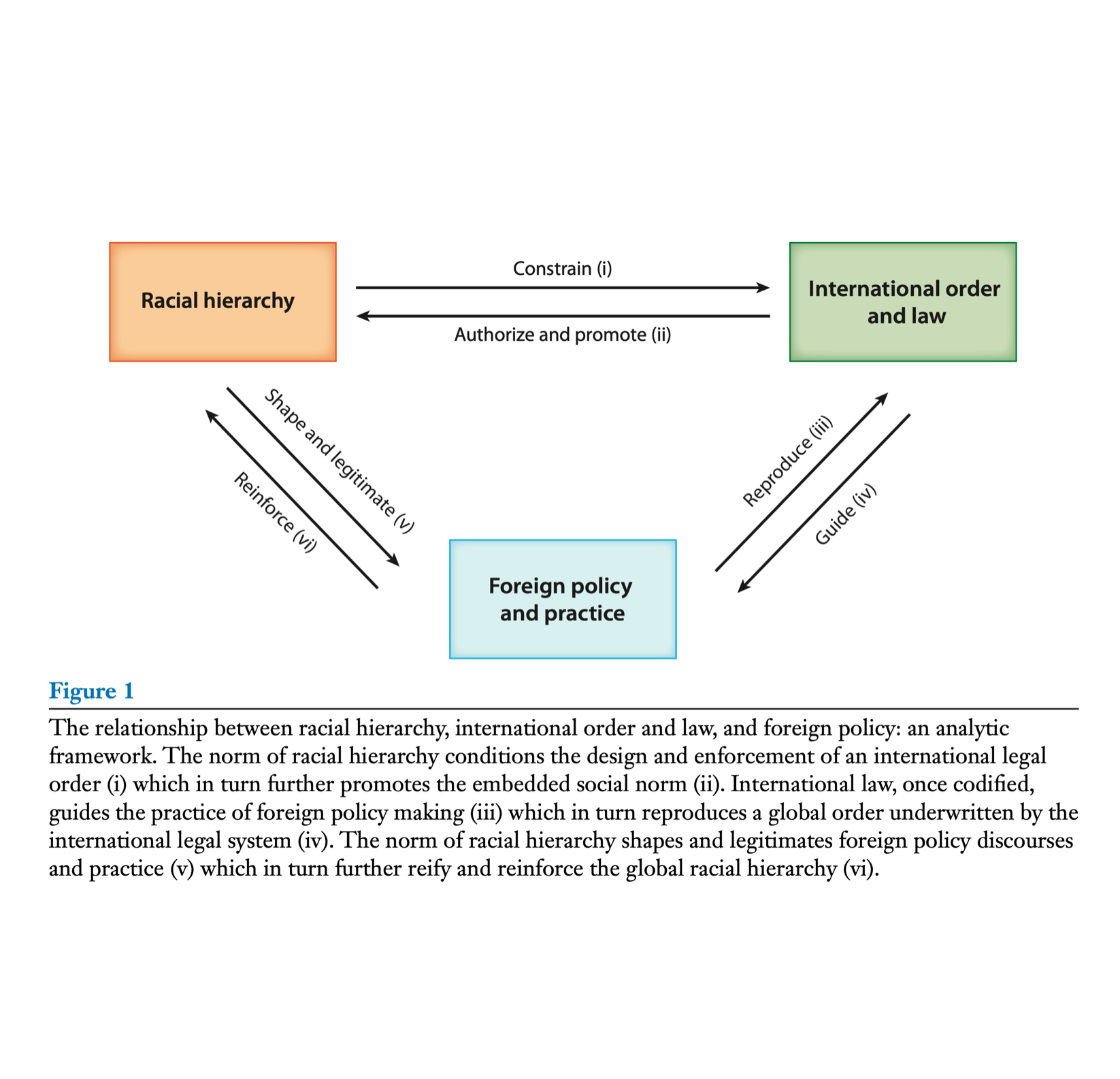
Freeman, B., Kim, D. G., & Lake, D. A. (2022). “Race in International Relations: Beyond the ‘Norm Against Noticing.’” Annual Review of Political Science, 25, 175-196.
The global movement for racial justice and the rise of anti-Asian hate at the height of the pandemic have called new attention to race and racism in international politics. Although critical theorists have decried the “norm against noticing,” other scholars of international relations have long sidestepped the possible role of race in shaping contemporary international affairs. New studies of hierarchy in international relations open the door for new understandings of race in world politics. We propose an analytic framework for the relationship between racial hierarchy, international law, and foreign policy, demonstrating that race can help explain patterns of interstate interactions that sustain an unequal global order. Positing two faces of racism in international relations, we examine how race biases international law in practice and affects the assessment of foreign threats and national interest. We discuss key methodological challenges in empirical research on race in international relations, focusing on issues of measurement, aggregation, and causation.
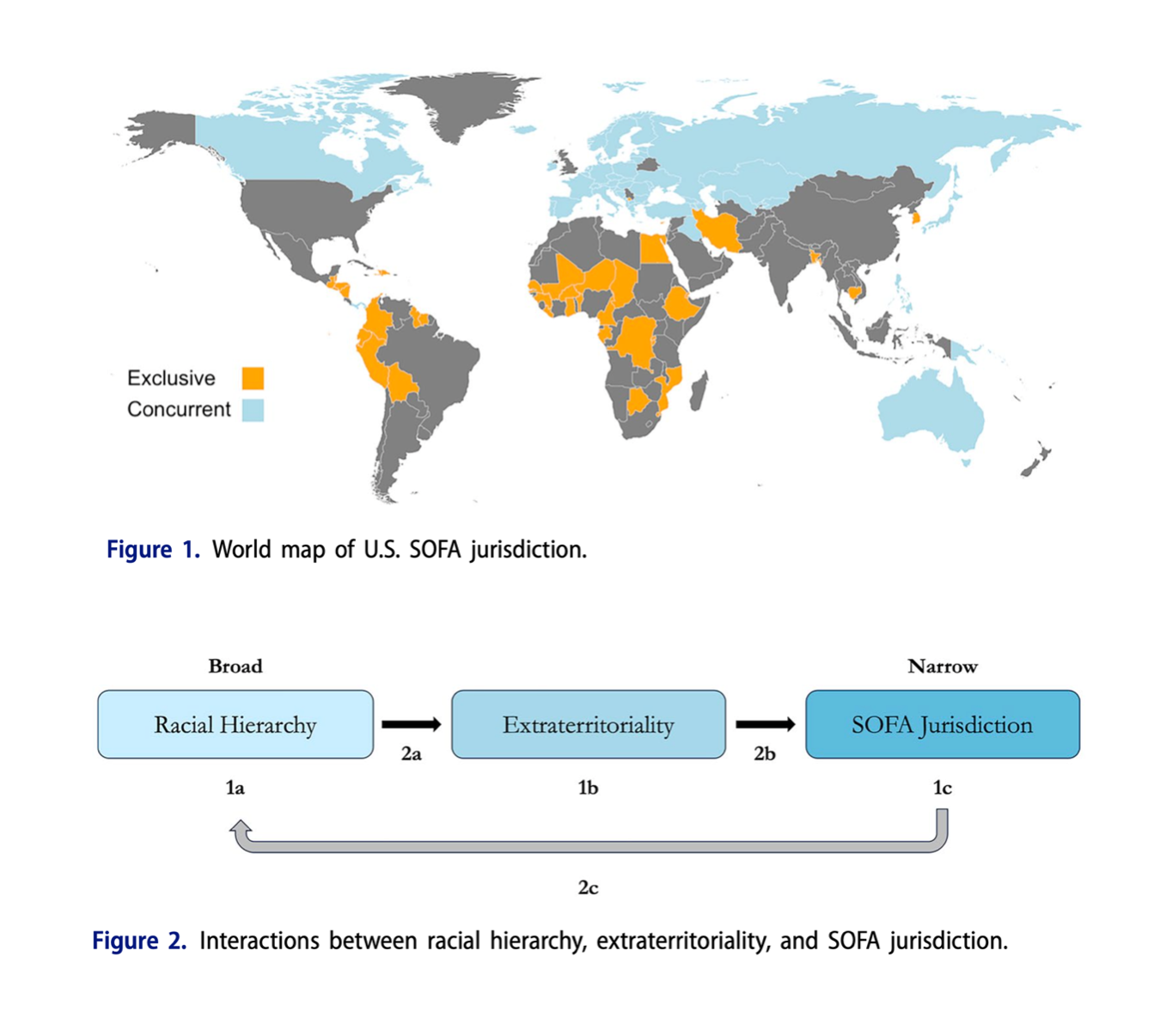
Freeman, B. (2023). “Racial Hierarchy and Jurisdiction in US Status of Forces Agreements.” Security Studies, 32(4-5), 748-774.
Status of Forces Agreements (SOFAs) establish when and how the domestic laws of host governments are applied to American soldiers. Why does the United States share jurisdiction under some SOFAs but not others? I argue that U.S. SOFAs project a racialized conception of host state capacity for governance over American troops on foreign soil. It is through the notion of “capacity” that non-white host partners are stereotyped as possessing inferior courts and legal values. The United States is less likely to share jurisdiction with non-white majority host countries. I motivate my argument with primary accounts of racial discrimination in debates over U.S. SOFA policy. Then, I code U.S. SOFA jurisdiction and estimate its determinants. The results suggest that the United States imposes concurrent jurisdiction to govern its interactions with predominantly white host states, allowing these peer countries to try U.S. personnel, while withholding this same right from most non-white host partners, ceteris paribus. I conclude with a discussion of implications for understanding international law and security from its racial underpinnings.
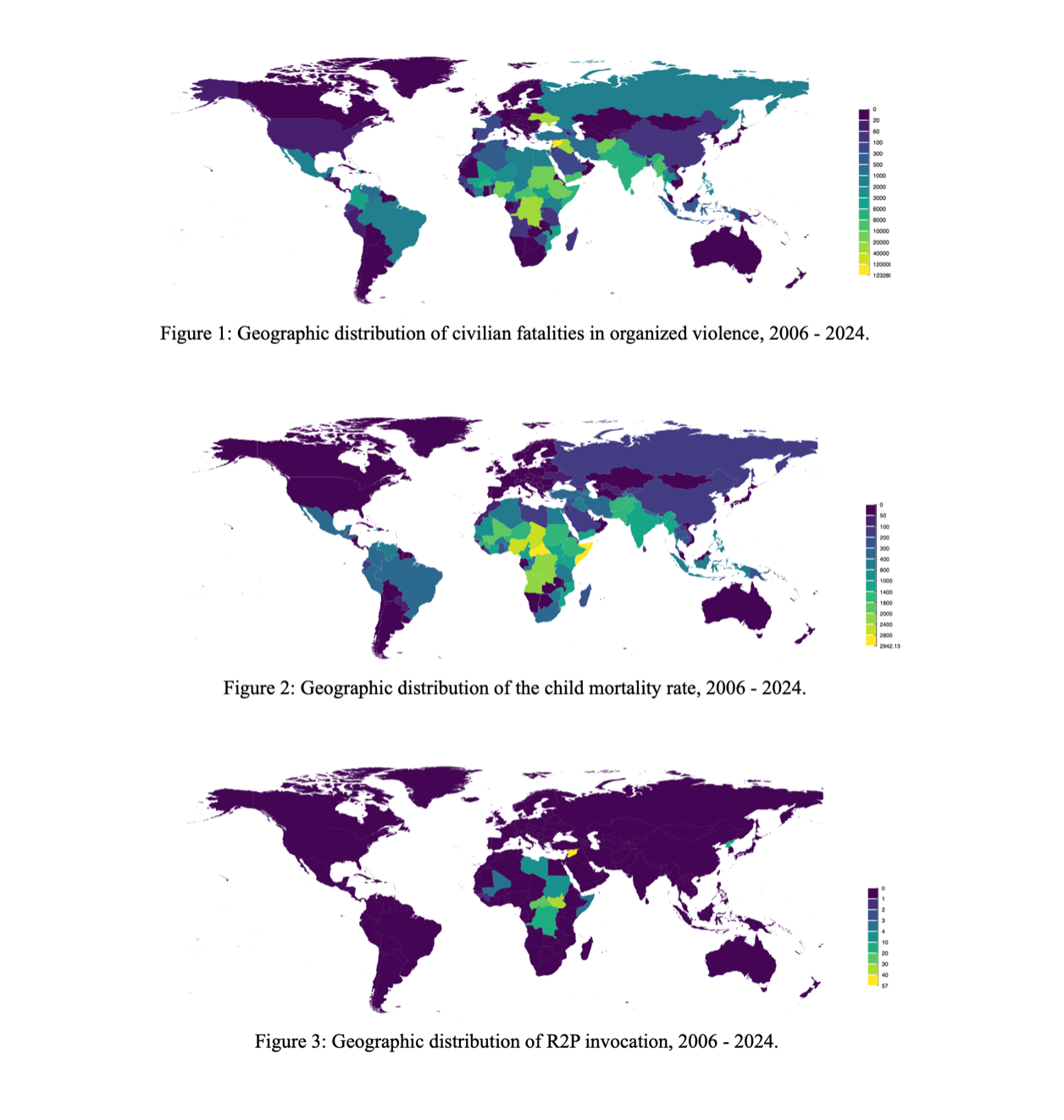
“Entrusting the Lamb to the Wolf: Race and International Intervention.” (preparing for submission).
The Responsibility to Protect (R2P) has been invoked in over one hundred resolutions since its formal endorsement by the UN General Assembly in 2005. Although R2P was designed to protect populations around the world from mass atrocity, the doctrine is selectively cited over countries in Africa. Why are most failures to protect attributed by the international community to African states? I argue that R2P betrays a racialized bias whereby the legal principle of sovereignty is transformed into a conditional privilege withheld from most African countries all else equal. Racism codifies Black people—and by extension, Black countries—as not only deficient and lacking capacity, but also more violent and prone to non-institutionalized political behavior. Both racialized dynamics then render majority Black countries irresponsible and in need of corrective, collective action by other (White) countries. Using original data on R2P invocations and mass atrocity events from 2006-2024, I measure the relationship between a country’s racial majority and the decision to intervene. The results suggest R2P is disproportionately invoked over African societies, controlling for various dimensions of state capacity, organized violence, and other explanations for R2P. Above capacity and violence in Africa, its racialization still matters for international intervention.
“Blue Line, Blue Helmet: Race and the Limits of Representation in Peacekeeping.” (with William Nomikos).
The vast majority of international interventions are conducted by Global North countries in the Global South. Despite this pattern, we know remarkably little about how race shapes the outcomes of those interventions. Recent work suggesting that local perceptions are central to the legitimacy and efficacy of intervention makes this omission particularly problematic. We fill this gap by proposing two mechanisms that develop race as a distinct explanation for peacekeeping (PKO) efficacy. To test our arguments, we examine the case of UN peacekeeping in sub-Saharan Africa. We merge existing geo-referenced, cross-national data on local populations and the deployment patterns of PKOs in order to measure a relationship between the likely perceived race of each peacekeeper and local violence reduction. We find that majority-Black communities are more likely to experience a reduction in violence when the peacekeeping unit is non-White compared to those perceived as White. Our study suggests that race can help explain the conditions under which peacekeepers reduce violence.